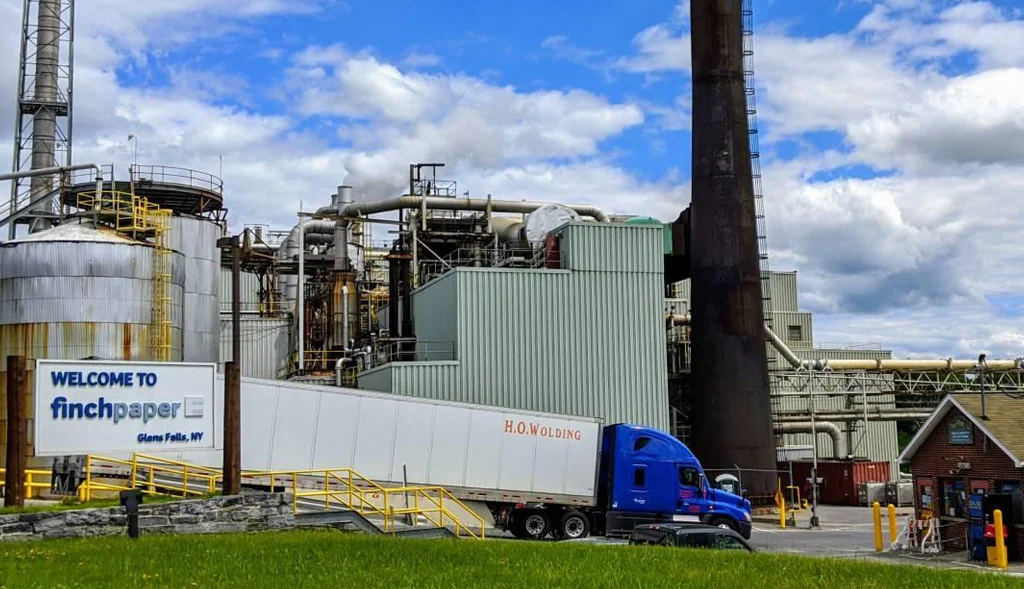
Finch Paper will cease pulp production at its Glens Falls mill in New York, ending decades of on-site pulping operations and significantly reducing its purchases of timber from forests across the Northeastern United States.
The company has decided to stop manufacturing pulp internally and will instead source market pulp from third-party suppliers. While pulp production will end, Finch confirmed it will continue manufacturing paper at the Glens Falls facility after completing a major modernization program.
The decision is expected to have significant repercussions for the regional forest products supply chain, affecting logging contractors, timber owners, trucking companies and forest management activities.
Transition to purchased market pulp
According to the company, purchasing market pulp has become more cost-effective than producing it internally. “Finch can now reliably purchase pulp less expensively than it can produce on site,” the company stated. The company did not disclose the identity or location of the new pulp suppliers. However, industry representatives indicated that the pulp could be sourced from Canadian producers or mills located in the southern United States.
“The company is making an eight-figure investment to improve the company’s capacity to receive and process greater amounts and a greater variety of purchased pulp,” said John Brodt, Vice President of Behan Communications. “We are also making some corresponding improvements to our paper machines and energy infrastructure. This investment represents a major commitment to the long-term sustainability and success of its Glens Falls paper mill.”
Major impact on the regional forestry sector
The closure of the pulp mill will eliminate one of the principal buyers of low-grade pulpwood in New York State. Following Finch’s exit, Sylvamo’s Ticonderoga mill will remain the state’s only major purchaser of this type of fibre. The Professional Logging Contractors of the Northeast warned that the decision could have widespread economic consequences for the regional forest sector.
“This is a significant loss for the region’s logging and trucking industry with far-reaching economic consequences as well as serious negative impacts on the ability to properly manage forest health,” the association said. Forestry consultant Timothy Burpoe also noted that Finch had historically sourced a substantial share of its fibre from forests in the eastern Adirondack region, where the loss of demand is expected to affect both employment and long-term forest management strategies.
Biomass operations to continue
Although pulp production will end, Finch Paper confirmed it will continue purchasing wood for its biomass cogeneration facility. The plant uses bark, sawdust and other wood residues to generate high-pressure steam required for paper drying operations, allowing the mill to maintain part of its relationship with regional wood suppliers.
The company previously owned more than 100,000 acres of timberland in the Adirondacks before selling those forest holdings more than two decades ago. Nevertheless, its continued purchases of pulpwood have remained an important source of demand for the regional forestry economy.
The shift to purchased market pulp marks a significant strategic change for Finch Paper as it seeks to improve the long-term competitiveness of its paper manufacturing operations while maintaining production at its historic Glens Falls mill.